
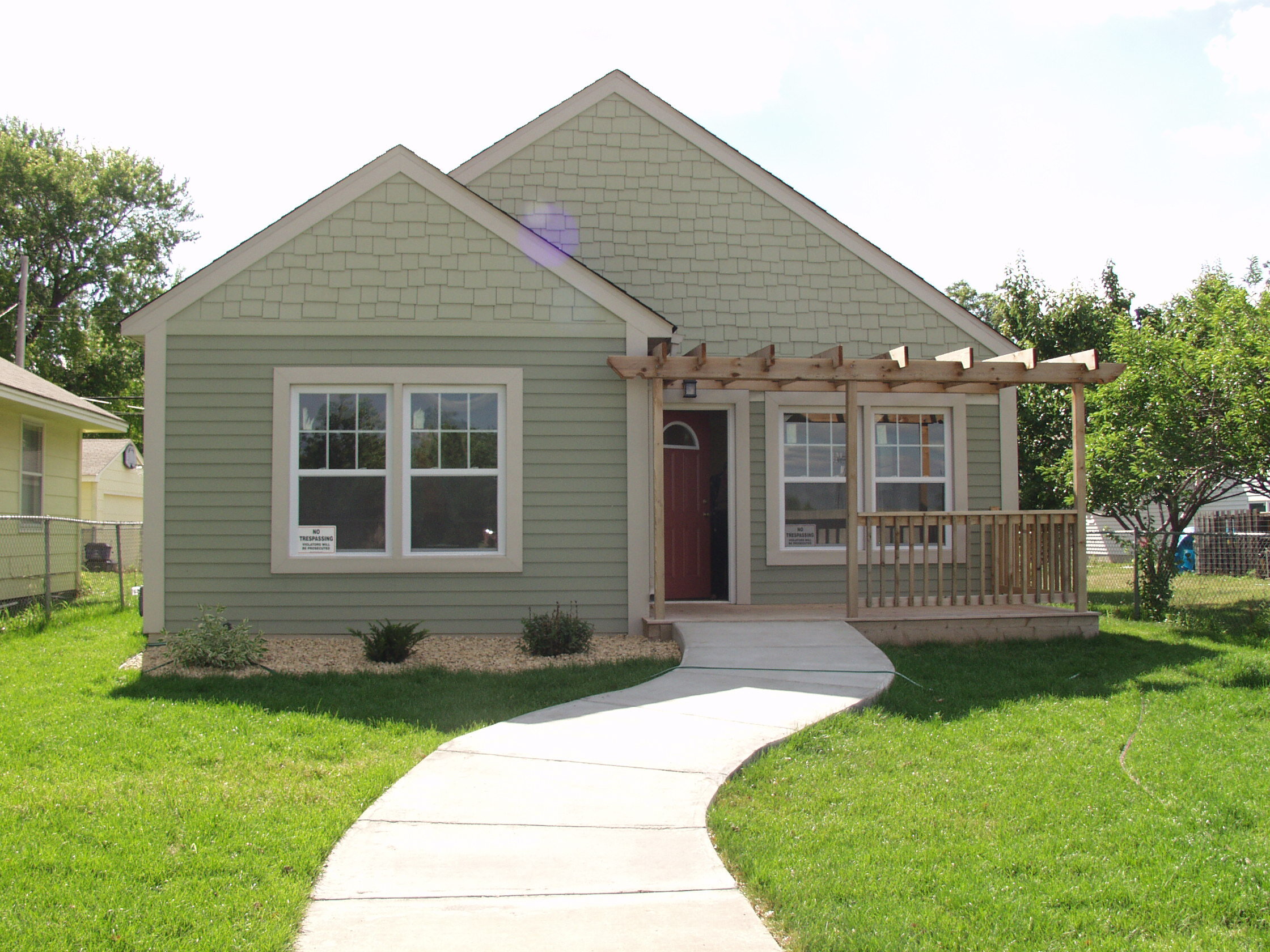
The Minneapolis Public Housing Agency (MPHA) owns and operates over 5,900 housing units, including 42 high-rise buildings that serve mostly elderly and disabled individuals. It is less commonly known that MPHA owns more than 700 single-family, duplex, and fourplex homes for families across Minneapolis. These “scattered sites” are particularly expensive to operate. Some are more than 100 years old. Compared to other types of public housing, staff must spend extra time travelling to each site to make repairs, and scattered sites require different materials and building components for each home. Despite these challenges, public housing operating funds from the federal government fall far short of these operating costs.
However, preserving these units long-term for the community was essential for MPHA. They constitute nearly 80 percent of MPHA’s housing for families with children. Unlike MPHA’s other housing, they are dispersed throughout the city, allowing MPHA to have a presence in a variety of neighborhoods and helping families feel they are part of the overall community. Among MPHA’s housing portfolio, scattered sites are the most likely to provide a family with a platform to save, plan, and train for future homeownership.
In 2018, the US Department of Housing and Urban Development (HUD) published a rulemaking notice that contained a potential solution. HUD stated that because of their unique operating challenges, scattered site public housing was a strong candidate for a section of federal housing law called “Section 18.” Section 18 contains many parts. The part of interest to MPHA involved changing the underlying subsidy from traditional public housing to project-based vouchers. For families, the change would be largely seamless. For MPHA, the project involved the necessary behind-the-scenes challenge of transferring the properties to a nonprofit foundation wholly controlled by the housing authority, and moving families to a new subsidy platform.
However, the payoff is worthwhile — assuring these homes will continue to serve extremely low-income families far into the future, while remaining a public asset. MPHA finalized the conversion under Section 18 in October 2020, unlocking at least $3 million in additional, annual federal subsidy to reinvest in the units. MPHA continues to own and manage the homes.
In the future, MPHA intends to leverage this additional subsidy to take out a loan for more extensive renovations—something impossible under traditional public housing—and to replace the limited number of homes that are beyond repair. MPHA also expects to add to its scattered site portfolio in the coming years, in part by expanding single family properties on lots that can support duplexes, triplexes, or fourplexes.
Beyond the financial benefits, the process allowed the agency to engage with residents directly and hear what would make their homes more live-able and functional in the long-term. At resident meetings prior to the application, staff needed to explain the financial and regulatory requirements while also assuring families that the conversion process would not result in displacement and would put the agency in a better position to make repairs and improvements to their homes.
MPHA’s successful use of Section 18 to preserve and retain more than 700 scattered site homes here in Minnesota appears to be a national precedent. HUD is working with MPHA to share what it has learned to help other housing authorities around the country do the same.
For more information contact Jeff Horwich, Director of Policy & Communications, MPHA at jhorwich@mplspha.org.
Follow MPHA:
Twitter https://twitter.com/MPLSPubHousing
Facebook https://FB.com/mplspublichousing
Website https://mphaonline.org/preserving-family-homes/