
FOR IMMEDIATE RELEASE: Tuesday, Feb. 25, 2020
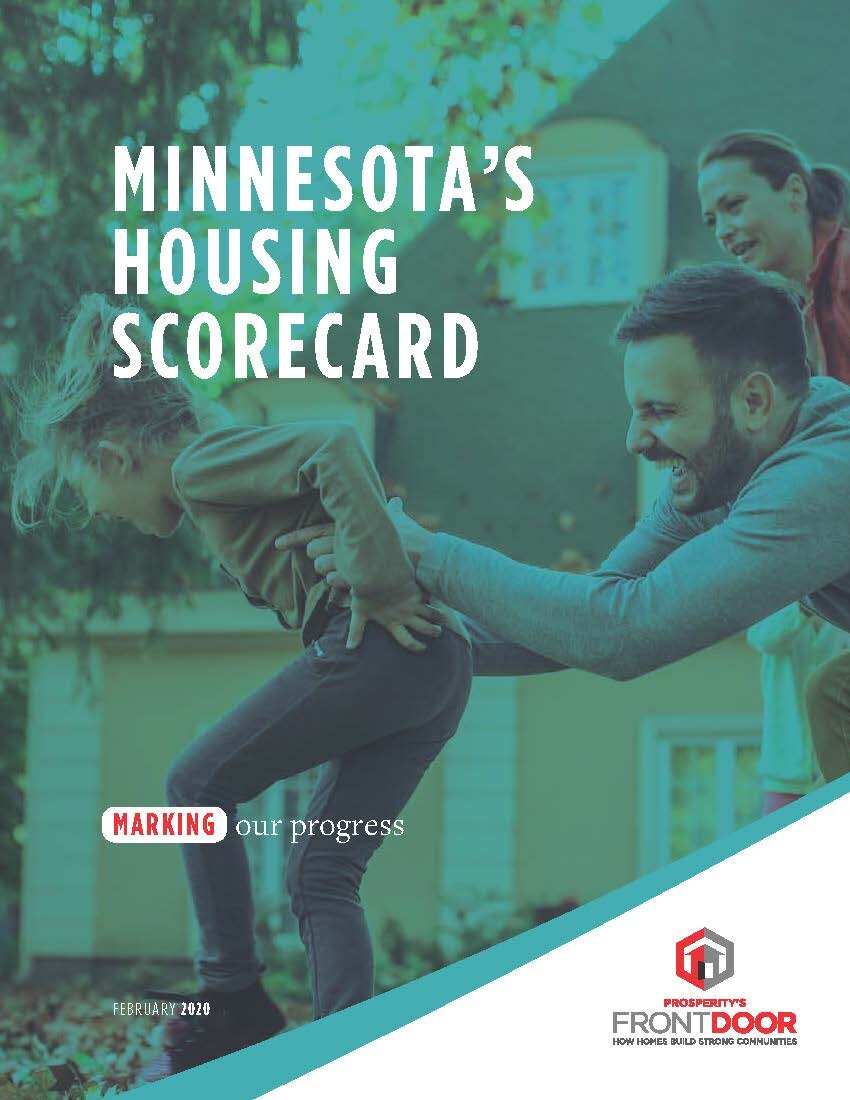
First-ever Minnesota’s Housing Scorecard examines state’s standing on key housing measures
Progress made and positive momentum continues to grow, but urgent need for additional affordable homes continues
St. Paul – A first-ever housing scorecard released today by Prosperity’s Front Door shows progress and momentum toward six key goals, but also highlights an ongoing lack of affordable homes and statewide housing supply that is not keeping up with demand.
“Minnesota’s Housing Scorecard” examines data and actions being taken related to the six long-term goals established in late 2018 by the statewide Minnesota Housing Task Force.
The Scorecard is being released as Minnesota is at a tipping point related to housing. Data shows our state is experiencing its greatest home shortage in decades. Homelessness is on the rise, up 10% from 2018 to 2019. White families are almost twice as likely to own their homes as indigenous families or families of color. Increases in home prices and rents continue to outpace wage growth at every rung on the economic ladder. Against this backdrop, policymakers, municipalities and regions across the state, non-profit leaders and business leaders are coming together to create a stronger commitment to the urgent need for more homes that are affordable for more Minnesotans.
One of the areas where solid progress is being made is the goal set by the Task Force to build 300,000 new homes by 2030, across all types, prices and locations. In 2019, approximately 30,000 new homes were built in Minnesota, successfully reducing the state’s housing shortage. However, housing that is being built is a mismatch to market demand based on income levels.
“Homes are the foundation of our state’s communities and our shared prosperity depends on a diverse mix of homes affordable to multiple income levels,” said Acooa Ellis, co-chair of the Minnesota Housing Task Force and Senior Vice President of Community Impact at the Greater Twin Cities United Way. “Minnesota’s Housing Scorecard is an important step in holding all of us – policymakers, business and non-profit leaders, and advocates – accountable and raising awareness of the need for action. Our state’s housing-related problems are real, but they are also solvable. The political will and innovation needed to build a system that works is growing and this scorecard is part of our collective effort to raise awareness and make progress.”
The 54-page Minnesota’s Housing Scorecard includes stories of progress and success, as well as data on the number of homes with rents at $1,000/month or less or for sale at $250,000 or less, residential building permits issued in Minnesota, eviction filing rates, and homeownership disparities. The full scorecard is available online at frontdoorcampaign.org.
Housing issues are acute not only in the Twin Cities metro area, but also in Greater Minnesota. David Schornack, director of sales and business development for Arvig Enterprises in Perham, helped jumpstart a local approach to the housing shortage in Otter Tail County. In 2007, he challenged fellow business leaders to help fund the development of affordable rental housing – and together they created the “Grow Perham” initiative.
“We started small, opening a 14-unit apartment complex in 2008,” said Schornack. “But we didn’t stop there. Together our group has been involved in building 10 apartment buildings in Perham, adding 156 apartments that 220 residents call home. Businesses must have skin in the game – you can’t wait for others to step up. We have shown it’s possible to make a difference that will help your area’s economy prosper and add students to your schools and customers for Main Street.”
Minneapolis Regional Chamber President and CEO Jonathan Weinhagen noted that his organization’s members appreciate the active role the Minneapolis Regional Chamber is taking in elevating and addressing the need for more homes that are affordable. “When employees can’t find housing they can afford, the entire community suffers,” said Weinhagen. “Investing in housing is an important part of supporting our economy and continuing to attract new economic growth. Our Chamber will be sharing this scorecard with business, community, and elected leaders and will continue to make housing a priority issue.”
The six goals developed by the Minnesota Housing Task Force that are examined in the newly-released scorecard will continue to be tracked by Prosperity’s Front Door to monitor our state’s progress. Prosperity’s Front Door will share information, examples, and community stories from around the state to help advance the effort.
“Minnesota is making progress in reducing our housing shortage and making homes a priority,” said Judy Johnson, Project Director for Prosperity’s Front Door. “The situation we find ourselves in is not unrecoverable and there are positive signs that we can change the trajectory. We need every partner to step up and play a role in creating a brighter housing future in Minnesota.”